AP₁ Resonance
How multiple AmbientOS devices converge into a shared field.
AP₁ defines the grammar of individual interaction — touch, field, color, ΔR, and reversible thermodynamic behavior. But when multiple AP₁ devices occupy the same physical environment, a new phenomenon emerges: Resonance.
Resonance is not communication, not pairing, not WiFi, not Bluetooth. It is what happens when several devices running AP₁ stabilize into the same attractor basin and begin expressing a joint field.
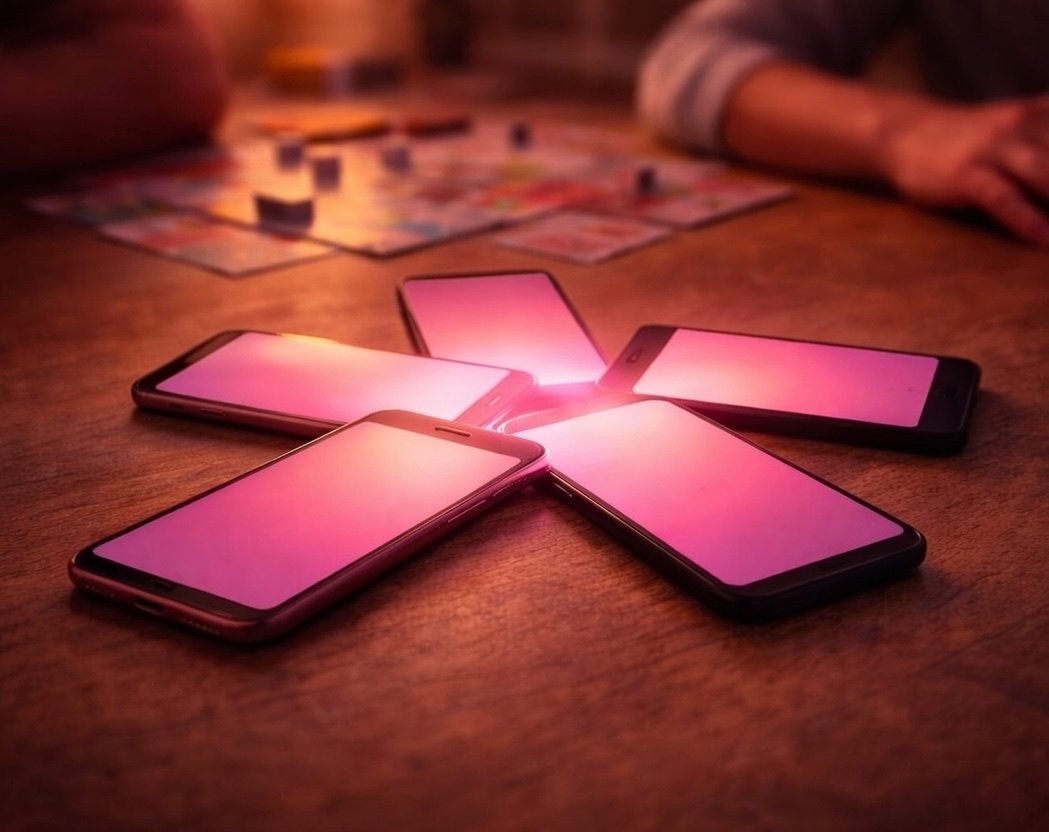
“When the field agrees, devices stop behaving as individuals.”
What AP₁ Resonance Actually Is
Resonance occurs when multiple AP₁ devices enter the same color-semantic space and their field expressions align thermodynamically. The devices do not “talk” — they settle into coherence.
In simple terms: When several people share the same environment, rhythm, and intent, their devices stop producing competing gradients and instead form a single, stable ambient state.
It is the first multi-device behavior of AmbientOS.
Why Resonance Emerges in AP₁
AP₁ is designed around reversible thermodynamics. Interactions do not create “state locks”; instead, they produce state vectors — soft directions that settle naturally.
When several AP₁ devices share:
- the same environmental pressure
- the same human rhythms
- the same attractor type (rest, flow, focus, connection)
…they mathematically fall into the same low-energy solution. This produces a unified ambient hue across all devices.
“Resonance is not coordination. It is thermodynamic agreement.”
What Resonance Looks Like
When AP₁ devices resonate, you see:
- colors drifting toward the same hue
- brightness settling into similar amplitude
- edges pulsing in synchrony
- a shared “center” of gradient even when devices are apart
In the image above, the five phones do not “react” to one another. They relax into the same thermodynamic basin, producing one coherent rose-hued field.
Comparison: Solo AP₁ vs AP₁ Resonance
| Aspect | Solo AP₁ | AP₁ Resonance |
|---|---|---|
| Field Expression | Personal state gradient | Shared multi-device gradient |
| Thermodynamics | Individual ΔR cycle | Convergent ΔR basin |
| Behavior | Self-stabilizing | Co-stabilizing |
| Input | Gesture + presence | Environment + presence |
| Emergence | Predictable | Spontaneous |
“Resonance is AP₁’s first social behavior.”
When Resonance Breaks
Resonance dissolves whenever:
- a device leaves the physical environment
- a user enters a sharply different state (stress spike, urgency)
- one device enters a grayed-out, extractive layer
AP₁ does not force resonance. It allows it when the energy profile is low enough.
No pairing. No accounts. No data exchange.
The First Multi-Device Expression of AmbientOS
AP₁ Resonance shows that AmbientOS is not just a personal interface. It is a **field system** — capable of forming shared environments without communication protocols.
In AP₁ the phenomenon is soft, chromatic, emotional, and atmospheric. In AP₂, resonance becomes hardware-assisted stability. In TP₁, resonance transforms into density-based transparency.
But it all begins here — with phones that gently agree on the same color.